PLACES
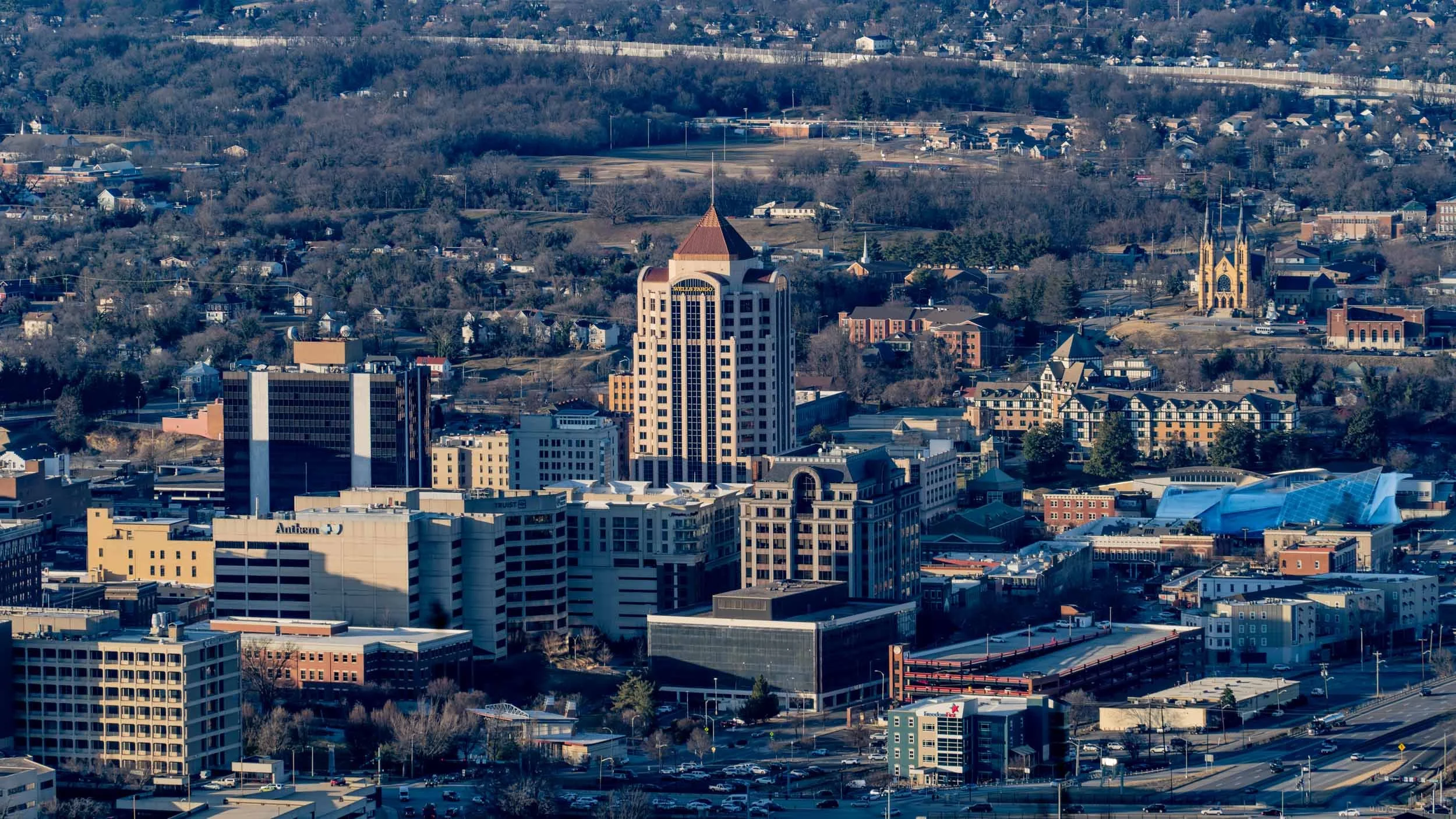
The image at the top of the page is downtown Roanoke. In the center of the photo is the largest building downtown, the Wells Fargo Bank building. Three other noteworthy structures, starting in the top righthand corner and going clockwise, are the Basilica of Saint Andrew (built in 1902), the Hotel Roanoke & Convention Center (built in 1882) and the Taubman Museum of Art / Fralin Center for American Art, which is the modern structure at the far right of the photo (built 2008). I took this picture of downtown Roanoke from the observation deck of the Roanoke Star on Mill Mountain.
The all white star changed to red, white and blue in September 2001 to honor victims of Sept. 11. On April 16, 2008 the star went dark on the first anniversary of the Virginia Tech shootings. The star changes to red, white and blue every year on Memorial Day, Flag Day, Independence Day, Patriot Day and Veterans Day.
The Roanoke Star, also known as the Mill Mountain Star, is the world's largest freestanding illuminated man-made star. It was constructed at the top of Mill Mountain in Roanoke in 1949 by the local merchants association to draw publicity and trade to the city.
It was initially created to be a seasonal Christmas decoration intended to shine over the city during the holiday shopping season. The “Star” was supposed to be dismantled in 1950 after the holiday season was over.
The star is actually three stars combined to make a single star. Each frame contains three to five sets of clear neon tubes — 2,000 feet of neon tubes weighing 10,000 pounds. The “Star: sits 1,847 feet above sea level and towers 1,045 feet above the city. It cost $28,000 to build.
The “Star” was lit for the first time at 8:22 p.m. on Nov. 23, 1949 by Roanoke Mayor A. R. Minton. John Payne, a Roanoke native and Hollywood star, traveled to attend the formal lighting ceremony. Less than 100 people braved the cold on Thanksgiving Eve to celebrate the Star’s lighting.
A canopy of colors where art takes flight at Garvan Gardens in Hot Springs, Arkansas, with “Where the Wind Lives,” a large-scale installation suspended above the natural landscape. This immersive exhibit transforms wind into movement, light, and color — creating a living, ever-changing experience. It also makes for a great photograph!
Spence Cabin is located in the Elkmont Historic District in the Great Smoky Mountains National Park. The cottage was built in 1928 during the transformation of the area from a logging town into an exclusive summer resort. This vacation home was part of the Appalachian Club; a place for escape to the mountains in the summer to enjoy tennis, picnics, dances and swimming in the chilly mountain stream waters. The unusual, striking contrast between the pink paint of the cabin walls and the teal-green shutters gives the picture a storybook quality. I half expect to see a “hobbit” come out of the door by the chimney with the stone archway.
A short distance from Spence Cabin were more modest cottages, and our family spent time in the summers there when I was a young child. I called the area “the Green Mountains.” I remember spending a night in Spence Cabin with my uncle, and we fished for rainbow trout in the stream that runs behind the cabin. I also remember that I didn’t catch any fish….
It’s hard to go wrong with a picture of a sunset. This picture was taken at Fairhope Pier in Fairhope, Alabama, which is just across Mobile Bay from - you guessed it - Mobile, Alabama (birthplace of Jimmy Buffett). It’s a fairly modest sunset. The stars of the picture are the couple walking hand in hand towards me, adding a touch of romance to the photo. The love-birds were completely unaware that my camera caught their intimate stroll. Unplanned candid shots such as this one are a pleasant surprise. In the original photo the couple was a bit more of a silhouette.
I edited the image by drawing a circle around the couple, lifted the shadows and increased the exposure to add small amount of light. These were subtle changes inside the circle, and the edge of the circle is like a wide, soft “feather” that very gradually fades outward and blends with the original lighting of the photo so it is much less noticeable.
The above photo is of a small fishing village in Nova Scotia, Canada. To me the star of the photo is the orange boat in the foreground. Weather beaten. Two fishing reels affixed to the top railing. Obviously the small boat has seen its time at sea. It probably has some stories to tell. Those who have piloted this craft are most likely hard working, hardscrabble fishermen.
Bar Harbor, Maine — a picturesque setting if there ever was one. The sea, the sky, the yachts and sailing ships of affluent sailors. Originally inhabited by the Wabanaki people and first settled by Europeans in 1763, Bar Harbor evolved from a quiet fishing village into a grand Gilded Age playground for America's elite. From the 1870s to the 1920s, families like the Rockefellers, Vanderbilts, Astors, Morgans, and Pulitzers built massive, ornate multi-room mansions.
A historic drought fueled a massive statewide forest fire in October 1947, destroying 67 grand summer estates and five major hotels in Bar Harbor. Unable or unwilling to rebuild after the combined impact of the Great Depression and the fire, the era of mega-mansions largely ended. Today the town has reinvented itself as a vibrant, year-round coastal community rooted in tourism, marine research, and is the gateway to Acadia National Park.
A vintage antique Ford truck parked alongside a Roanoke neighborhood road on a beautiful autumn afternoon. There is really nothing to say about the picture that it doesn’t already say for itself. Mother Nature showcasing a piece of Americana.
PLACES Gallery Pages